Per-engine citation volatility: why one model update does not move all answer engines
Learn why citation shifts in ChatGPT, Gemini, Perplexity, Claude and Google AI Mode must be measured per engine, not as one blended AEO score.
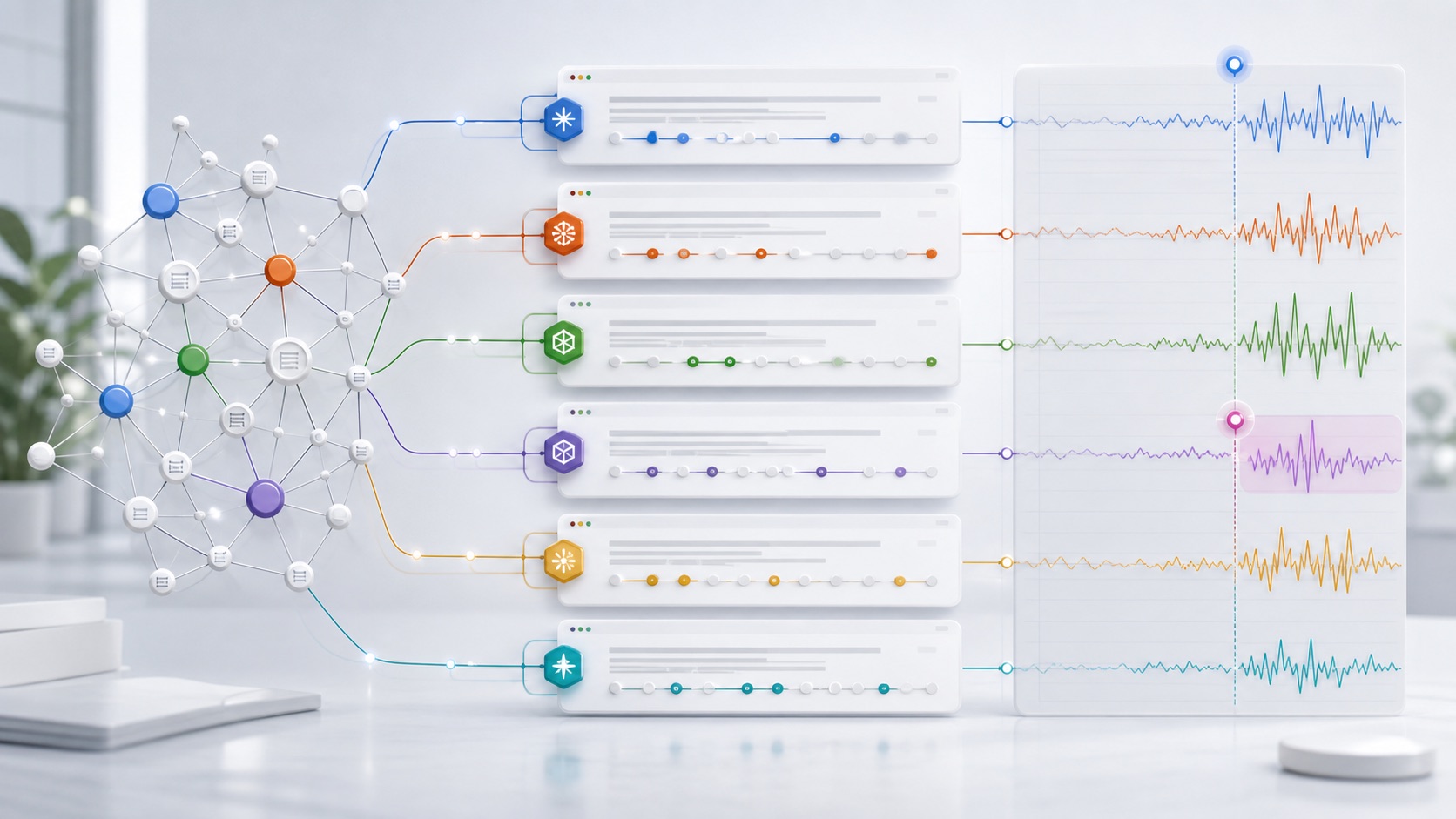
Per-engine citation volatility is the tendency for cited sources to change inside one answer engine without the same movement appearing in every other engine. A ChatGPT model update can reshuffle ChatGPT citations while Gemini, Perplexity, Claude or Google AI Mode continue to cite a different set of sources for the same prompts.
That distinction matters because many AI visibility reports still compress every engine into one score. The result looks simple, but it hides the most useful signal. If a brand loses citations in ChatGPT and gains citations in Perplexity, a blended number may show a flat trend even though the diagnosis, the risk and the next action are completely different.
A model update is not an internet-wide citation update. Measure citation movement by engine first, then decide whether there is a broader pattern.
Why answer engines do not move together
Answer engines share a visible interface: the user asks a question and receives a generated answer with supporting sources. Under the surface, they differ in when they search, how many sources they retrieve, which indexes they lean on, how they rank evidence, how they present links and how often they refresh their models.
A retrieval-heavy engine can react quickly to new pages, while a generative-first engine may answer many prompts without a fresh web search. Google AI Overviews and AI Mode are tied to Google Search systems, but even those two Google surfaces can cite different URLs for very similar answers. Perplexity tends to expose source work more consistently. ChatGPT is more selective about live web retrieval and often shows fewer citation slots.
This means “AI search” is not one channel in measurement terms. It is a portfolio of engines with different citation economics. Treating them as one system is similar to mixing organic rankings, paid search, referral traffic and PR mentions into one number and calling it visibility.
The evidence for per-engine measurement
Large citation studies point in the same direction: overlap between engines is limited. SurfacedBy found that most cited domains appeared in only one engine, while only a small minority appeared across all five engines in its sample. The same study also showed that average source counts vary sharply by engine, with ChatGPT using far fewer cited sources than Gemini or Perplexity.
Other research reinforces the point inside Google itself. Ahrefs found that AI Mode and AI Overviews can reach similar conclusions while citing different URLs. seoClarity’s work on ChatGPT citations also shows why a single snapshot is dangerous: what looks like a lasting decline can become a volatility pattern when the time series extends.
The practical conclusion is not that one study should become a universal benchmark. It is that every serious AEO measurement system needs engine-level rows, time-series context and prompt-level evidence. Without those three layers, the report cannot distinguish a model update from a site problem.
What changes after a model update
A model update can affect several parts of the answer pipeline. It can change query interpretation, retrieval thresholds, source diversity, summarization style, citation density, freshness sensitivity and how aggressively the system avoids weak sources. Some of those changes are visible as fewer links. Others appear as a different source mix, a shift from publishers to forums, a preference for official docs or a stronger weighting of recent pages.
The same update does not automatically propagate to every engine because every engine has its own model stack, retrieval strategy and product surface. A ranking shift in Google AI Overviews does not prove a ChatGPT issue. A ChatGPT citation loss does not prove that Perplexity stopped trusting the source. A Perplexity gain does not mean the brand has become universally more visible in AI.
How to diagnose citation volatility without overreacting
The first diagnostic rule is to separate platform movement from owned-site movement. If citations drop only in one engine while technical access, indexing and content remain stable, the likely cause is engine-side volatility. If the drop appears across several engines and several prompt groups at the same time, the site or source graph deserves closer inspection.
- Freeze the prompt portfolio before comparing movement, so the query set does not change during the analysis.
- Score citation, mention and recommendation separately; a source can be cited without being recommended.
- Keep one row per engine and avoid averaging engines until the per-engine pattern is understood.
- Record the cited URL, domain, answer position, citation context and whether the brand is named positively, neutrally or negatively.
- Check technical access for search-oriented crawlers and user-triggered fetches before attributing every loss to the model.
- Compare direct competitors and neutral reference sources, not only your own domain.
- Wait for repeated samples before rewriting content because one run can reflect sampling noise.
A practical example
Imagine a B2B software brand tracking thirty evaluation prompts across ChatGPT, Gemini, Google AI Mode, Perplexity and Claude. ChatGPT stops citing the brand’s comparison guide in several “best platform” prompts, but Perplexity keeps citing it, Gemini starts citing an implementation page and Google AI Mode moves toward third-party review pages.
A blended score might say visibility is slightly down. A useful AEO read says something more precise: ChatGPT citation slots became more competitive for comparison prompts; Gemini found a stronger technical page; Google needs better third-party evidence; Perplexity did not confirm a broad authority problem. Those are four different actions, not one generic content rewrite.
Which metrics to keep separate
The smallest useful reporting unit is not “AI visibility”. It is an engine, a prompt group, an outcome type and a cited source. From there, a team can aggregate carefully without losing the diagnosis.
- Citation rate: how often the engine links to or names a source as support.
- Mention rate: how often the brand appears in the answer, cited or not.
- Recommendation rate: how often the engine actively selects the brand as a suitable option.
- Source mix: owned pages, third-party editorial pages, directories, forums, documentation, marketplaces and review sites.
- Citation drift: the share of citations that move to different domains or URLs between samples.
- Answer context: whether the citation supports a definition, comparison, claim, risk, price point or recommendation.
How to respond by engine
When one engine moves, resist the urge to change every page. First identify what that engine appears to reward in the affected prompt group. If ChatGPT cites fewer pages, strengthen direct definitions, source clarity and crawl access. If Google AI Mode shifts toward third-party sources, improve entity consistency and external evidence. If Perplexity continues to cite a page, preserve the passage that works before editing around it. If Claude prefers established sources, consider whether the answer needs better provenance rather than more on-site copy.
The response should usually be a portfolio action: improve one owned page, add or clarify structured data where it matches visible content, earn or update third-party evidence, fix crawler access if needed, and then rerun the same prompts. The goal is not to chase every answer variation. The goal is to make the evidence graph easier for each engine to retrieve and trust.
Common mistakes
- Using one blended AI visibility score as the primary diagnosis.
- Treating a ChatGPT movement as proof that all answer engines changed.
- Publishing new pages before checking whether crawler access or indexing changed.
- Confusing citation loss with recommendation loss.
- Ignoring third-party sources when the engine is citing directories, media or community pages.
- Comparing different prompt sets before and after an update.
- Changing content after one unstable sample instead of waiting for repeated evidence.
FAQ
Does a ChatGPT model update affect Gemini citations?
Not directly. Gemini has its own model, retrieval system and Google Search context. A ChatGPT update can change ChatGPT citations, but Gemini citations must be measured separately before assuming the same movement exists there.
Should AI visibility reports use one score?
A summary score can be useful as an executive overview, but it should never be the diagnostic layer. The report needs per-engine citation, mention and recommendation data so teams know what actually moved.
How often should citation volatility be checked?
Use a fixed sampling rhythm and increase checks around known product or model changes. The important part is consistency: the same prompts, engines, competitors and scoring rules must be preserved across samples.
Conclusion
Per-engine citation volatility is not a reporting nuisance; it is the signal. Answer engines retrieve, rank and cite sources differently, so a real AEO program measures them separately before aggregating. When a model update lands, the winning team is not the one that rewrites everything fastest. It is the one that can tell which engine moved, which prompt group changed, which source type gained ground and which action is justified by evidence.